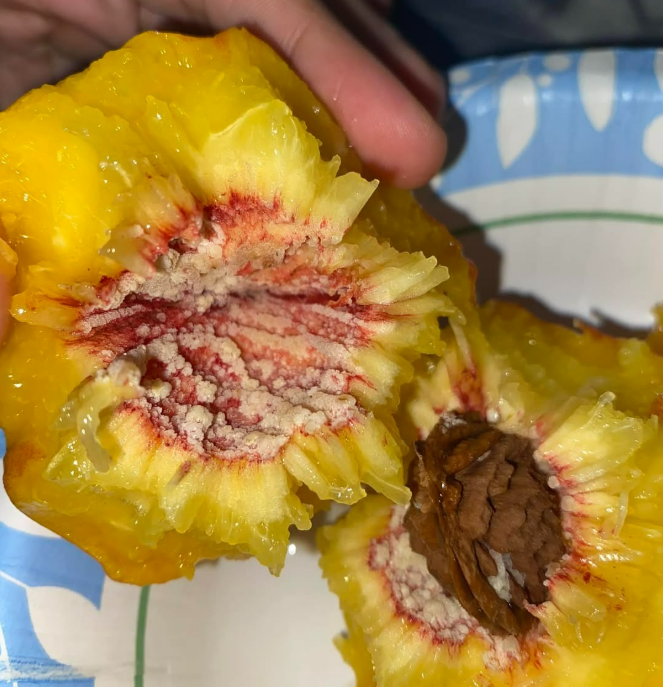
You’re enjoying a perfectly ripe, juicy peach—the kind that tastes like pure summer. As you twist the fruit open and remove the pit, you notice something unusual: a fuzzy, white, cotton-like substance clinging to the stone.
Your first thought?
Is it mold?
Is the peach spoiled?
Is it safe to eat?
Take a deep breath.
That white substance is not mold, rot, or contamination.
It’s something completely natural called peach callus tissue, and it’s perfectly harmless.
In fact, its presence often means you’re eating a fresh, tree-ripened peach.
Let’s take a closer look at what it is, why it appears, and when (rarely) you should be concerned.
What Is Peach Callus Tissue? (Science, Made Simple)
Peach callus tissue is a cluster of undifferentiated plant cells that forms naturally on the surface of the pit (the endocarp) as the fruit develops.
You can think of these cells as the peach’s version of stem cells—they haven’t specialized yet. In nature, if the pit falls to the ground and begins to sprout, this tissue can help initiate early root development.
In your kitchen, though, it’s simply a harmless byproduct of the peach’s natural growth. It has no taste, no smell, and no negative effect on the fruit.
Fun fact: Horticulturists actually use callus tissue in laboratories to propagate new peach trees through tissue culture.
Why Do Some Peach Pits Have It—and Others Don’t?
Not all peaches show callus tissue, and that’s completely normal. Its appearance depends on several factors:
Continued on next page: